.svg)
%204.svg)
Over 3,500 sinks installed
Contact Us
Thank you! Your submission has been received!
Oops! Something went wrong while submitting the form.
Undermount sinks are the most popular style in Florida kitchens — clean, seamless, and beautiful under granite or quartz. But there's a vulnerability that most homeowners don't think about until it's caused real damage: the silicone seal between the sink and the underside of the countertop. In Florida's climate, that seal has a harder job than anywhere else in the country — and when it fails, the consequences are invisible until they're expensive.
The silicone bead between an undermount sink and the countertop does two things: it keeps water from infiltrating the gap between the sink rim and the stone, and it helps hold the sink in place along with the mounting clips. Every time you run water in the sink, splash while washing dishes, or wipe down the counter, some water inevitably reaches that junction. A sound seal sends it into the basin. A failing seal lets it behind the stone and into the cabinet below — where in Florida's humidity, it has nowhere to go but into the wood.
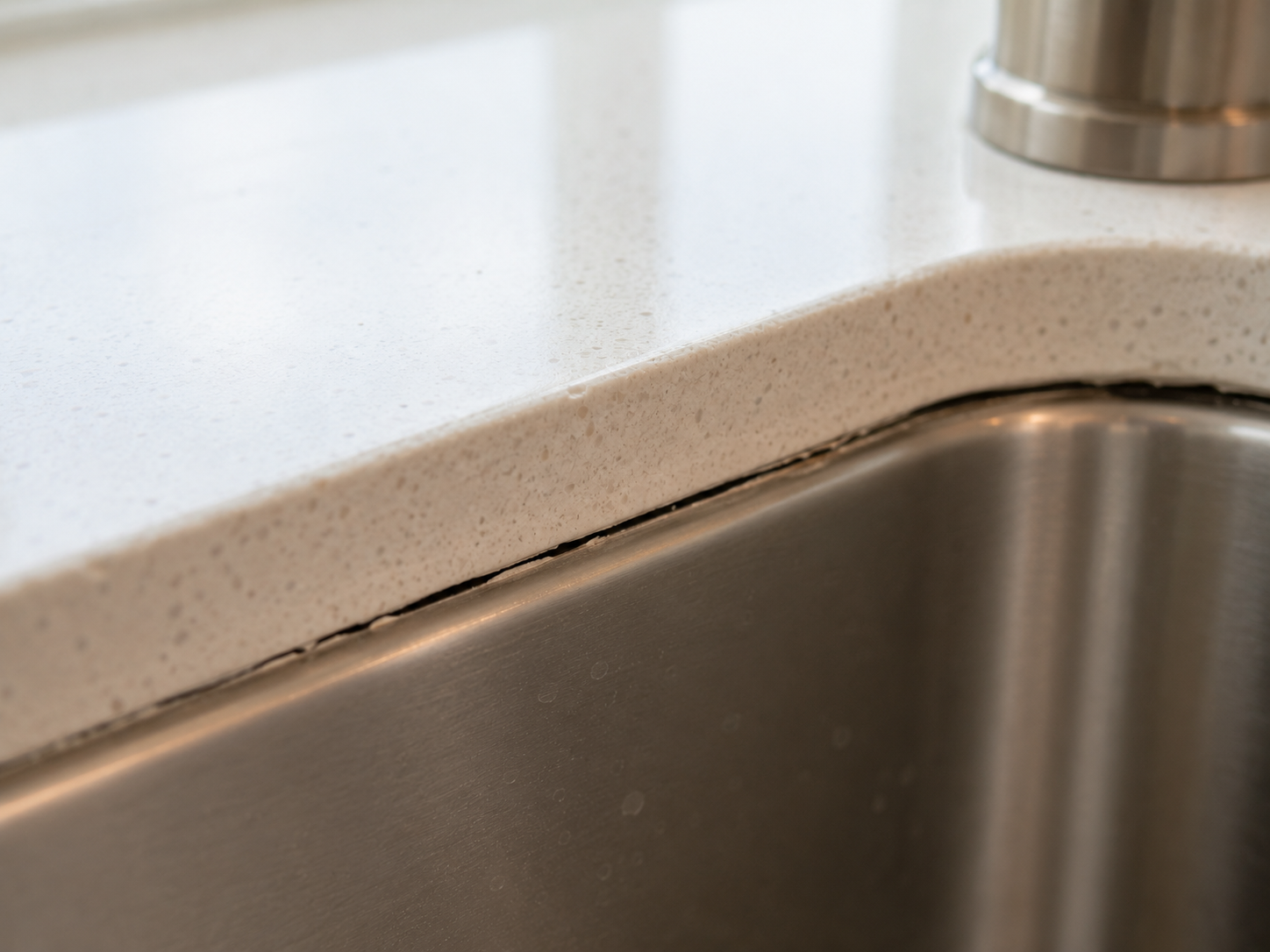
The earliest sign is often visual: a hairline gap between the countertop edge and the sink rim, or a slight darkening of the silicone that indicates mold beginning to grow in the joint. You might notice the sink has very slight movement when you press on one side — a sign the adhesive bond has partially released. A musty smell from under the sink cabinet that persists after cleaning is another strong indicator. And in advanced cases, you may see water staining or soft spots in the cabinet floor directly below the sink cutout.
Pro Tip: Once a month, dry the countertop area immediately around the sink rim completely and press a piece of paper towel against the junction between the sink and countertop. If it comes back with any moisture, the seal has failed and needs immediate attention — even if there's no visible gap.
Silicone sealants are rated for a range of temperature and humidity conditions — but Florida's climate pushes those conditions harder than most. The constant cycling between air-conditioned interiors and hot, humid exterior air causes micro-expansion and contraction in both the stone countertop and the sink material. Over years, this movement fatigues the silicone joint, which gradually loses its elasticity and develops microcracks that allow water infiltration. A seal that might last 15 years in a dry climate may need replacement in 7 to 10 years in a Southwest Florida kitchen.
Sometimes. If the sink itself is in good condition, a professional re-seal — removing the old silicone, drying the joint thoroughly, and applying new sealant — can restore the watertight connection without full replacement. The sink needs to be temporarily supported while the old adhesive is removed and the new bead cures. This is a job that requires proper technique around stone countertops — rushing the cure time or applying inadequate adhesive coverage is what causes the next failure to happen sooner than it should.
If the sink is old, visually worn, or has other issues — rust near the drain, surface damage, or outdated style — a re-seal is putting new effort into an old problem. Replacing the sink at the same time the seal is failing means one visit, one result, and a fully renewed installation with a fresh seal, new mounting hardware, and new supply line connections — everything reset at once.
A failing seal is a slow problem that becomes a fast expense if ignored. The good news: it's straightforward to address when caught early. Let us take a look before it becomes a cabinet replacement conversation.

.svg)
.svg)

.png)
