.svg)
%204.svg)
Over 3,500 sinks installed
Contact Us
Thank you! Your submission has been received!
Oops! Something went wrong while submitting the form.
Your kitchen sink works harder than almost anything else in your home. It handles dishes, produce, pots, cleanup, and the occasional science experiment from the back of the refrigerator. So when it starts looking tired or acting up, it's natural to wonder whether a repair will do or whether it's time to replace it.
The short answer: if the problem is in the sink itself (the basin, the finish, or the way it's attached to your countertop), replacement is usually the lasting fix. If the problem is limited to the faucet, drain, or a single fitting, a repair may be all you need. Here are the signs that point toward replacing your kitchen sink.
A hairline crack in a porcelain or composite basin may look like a cosmetic flaw, but it can let water seep into places you can't see. Chips that expose the metal or material underneath can also start to rust, stain, or spread. Small surface scratches on stainless steel are normal, but deep gouges that catch a fingernail and collect grime are a different story.
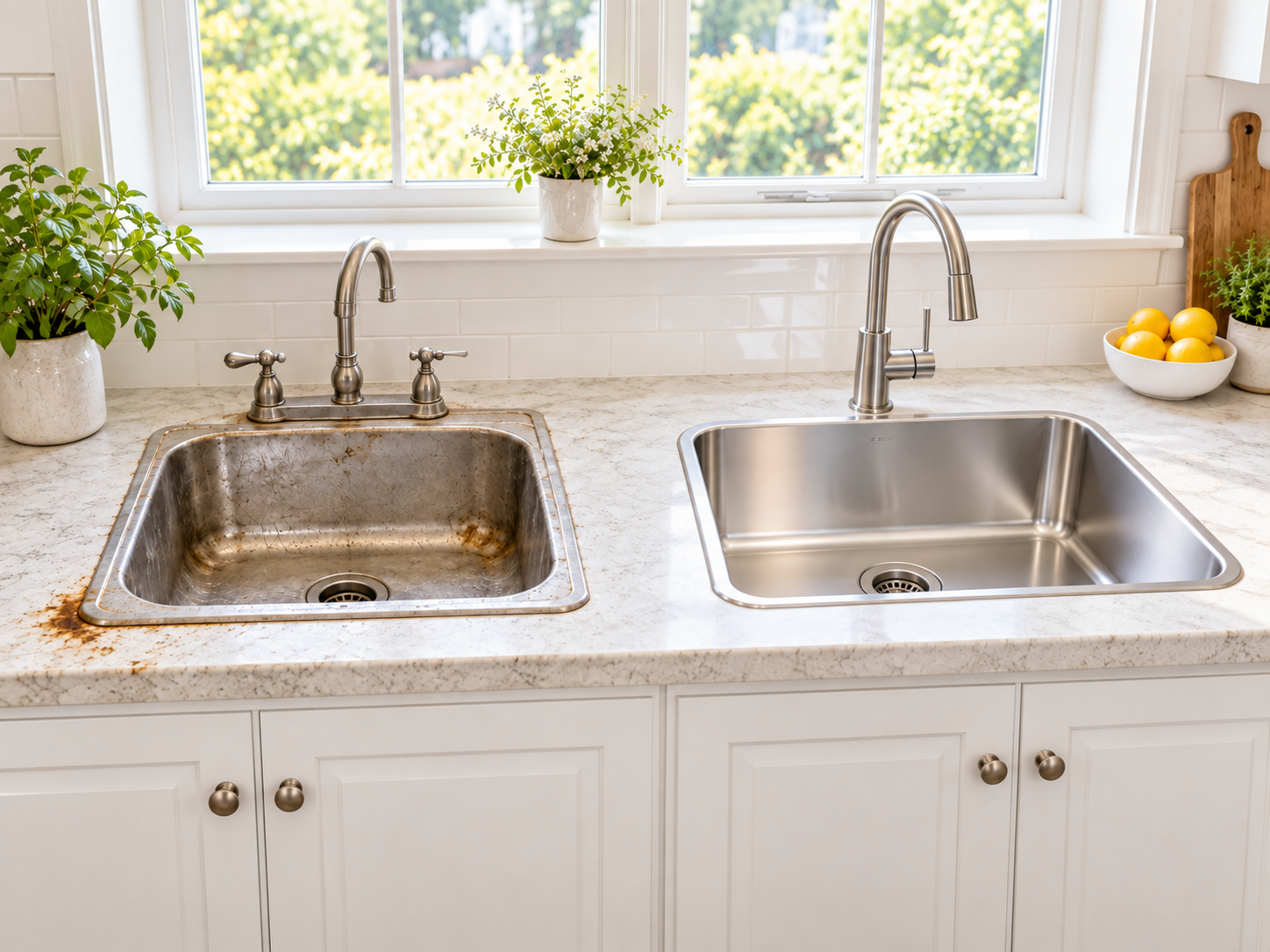
If you've tried the usual cleaning methods and the basin still looks yellowed, dull, or blotchy, the finish itself may be worn down. Some sinks stain permanently once the protective surface has been damaged. Rust spots on stainless steel often signal a damaged surface or trapped debris, and they tend to return even after scrubbing.
Water under the cabinet isn't always the sink's fault. Loose supply lines and worn drain fittings are common culprits. But if leaks keep returning around the sink rim, the drain opening, or the seam where the sink meets the countertop, the sink's mounting or seal may be failing. Ongoing moisture can damage the cabinet floor, so it's worth having a professional look sooner rather than later. Please don't tighten or disassemble plumbing you're not comfortable with, since small mistakes can turn into bigger leaks.
An undermount sink is supported from below, and a top-mount sink is held by clips and sealant. If you notice a gap between the sink and the counter, a basin that shifts when you lean on it, or caulk that keeps separating, the sink may no longer be securely supported. That is more than a cosmetic annoyance. In some cases, restrapping or resecuring the sink can solve it. In others, especially with an aging or damaged sink, replacement is the more reliable path.
Sometimes the sink isn't broken. It just doesn't work for you anymore. A shallow basin that splashes constantly, a divider that makes it hard to wash a sheet pan, or a tiny single bowl in a busy household are all valid reasons to upgrade. A sink that fits your routine makes everyday tasks feel easier.
You don't need a structural reason to replace a sink. If the color, shape, or material clashes with your countertops and cabinets, it can make an otherwise nice kitchen feel dated. Many homeowners are surprised by how much a new sink changes the way the whole room looks.
Repair often makes sense when the problem is isolated to a component such as a faucet, sprayer, or drain fitting. Replacement often makes sense when the damage is in the basin, the finish, or the support, or when several small problems keep coming back. A specialist can inspect the sink, the countertop, and the plumbing and tell you which category you're in.
A little preparation helps a specialist give you a useful answer the first time. Before anyone visits, take a few photos of the sink, the countertop around it, and the inside of the sink cabinet. Write down what you've noticed and when: a slow leak that only shows up when the dishwasher runs, a crack that seems to be growing, or a wobble you feel only when you lean on the counter.
It also helps to think about what you'd like from a new sink. Do you want more room for large pots? A different material? A cleaner look? Jot down a few priorities so you can talk them through.
Finally, resist the urge to tighten fittings or pry at a loose sink. Homeowners often make a problem larger while trying to fix it. Clear the cabinet, keep a towel or bucket handy if there's a drip, and let a professional take it from there.
Many homeowners put off replacing a sink because they assume it means tearing out the countertops. That isn't always the case. I Hate My Sink specializes only in kitchen sink replacement, and our approach is built around a simple idea: one sink, one day, no kitchen demolition.
Depending on the existing sink, countertop, dimensions, and installation requirements, a sink may be replaced while keeping your existing countertop and cabinets. During a free estimate, a sink expert looks at your current setup, explains your options, and lets you know what your specific installation would involve. We've replaced more than 3,500 sinks, and our work is backed by a 100% customer satisfaction guarantee.
If the damage is to the basin itself, such as cracks, worn finish, deep stains, or a sink that's loose from the countertop, replacement is usually the more dependable solution. Problems limited to the faucet or drain are often repairable.
Often, yes, though it depends on the existing sink, countertop material, dimensions, and installation requirements. A specialist can inspect your setup and confirm what's possible.
It varies with the material, how the sink is used, water quality, and how well it's maintained. Rather than counting years, watch for the warning signs above.
No. Leaks frequently come from supply lines, drain connections, or the faucet. A professional can find the true source so you don't replace something that doesn't need it.
Note the symptoms, take a few photos, and schedule an evaluation with a sink replacement specialist. I Hate My Sink offers free estimates.
If your sink is cracked, stained, leaking, or simply wrong for your kitchen, I Hate My Sink can evaluate your existing setup and help determine the right replacement solution, without unnecessarily tearing apart your kitchen.

.svg)
.svg)

.png)
