.svg)
%204.svg)
Over 3,500 sinks installed
Contact Us
Thank you! Your submission has been received!
Oops! Something went wrong while submitting the form.
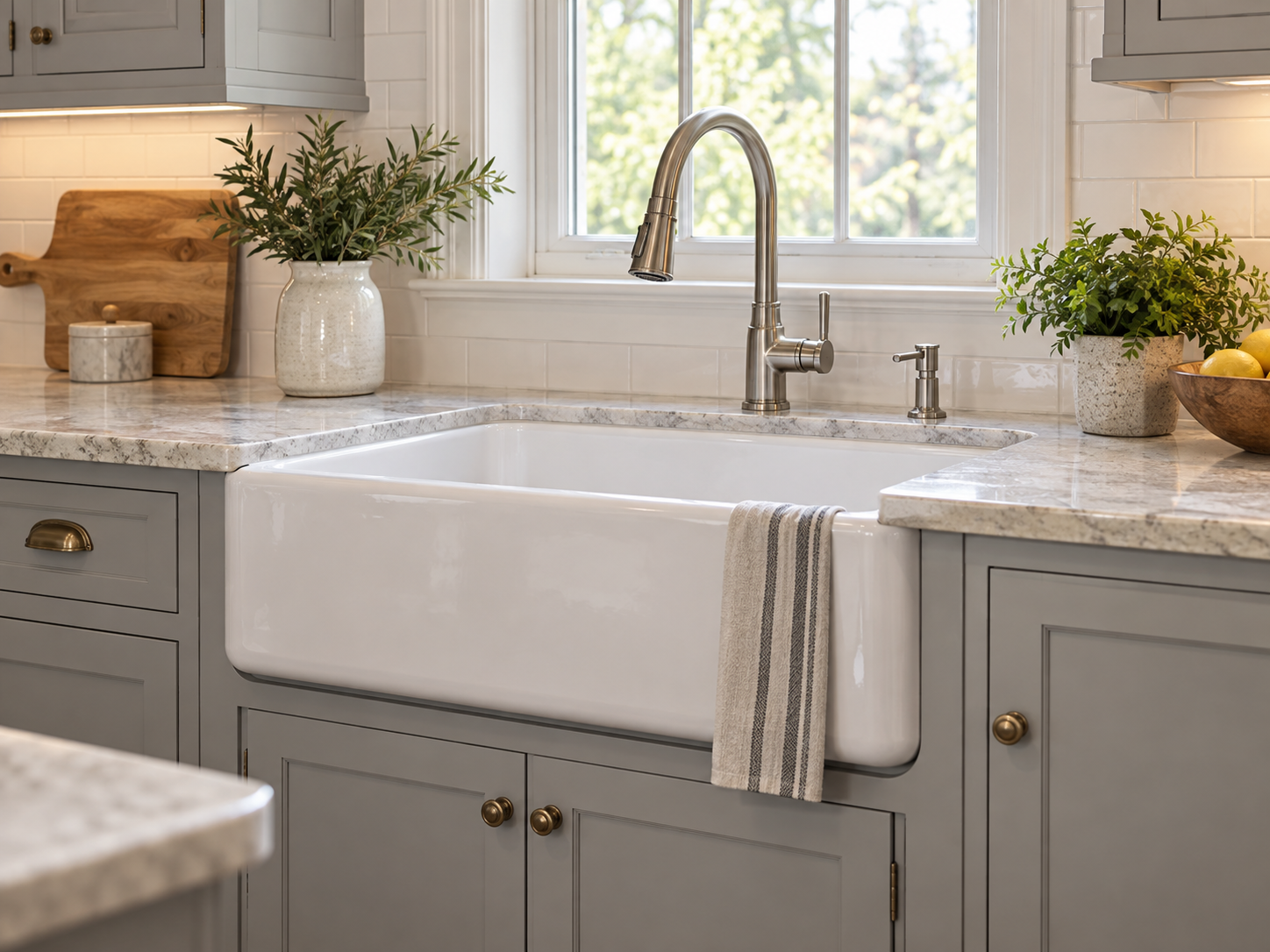
Fireclay sinks have a look that's hard to imitate: smooth, glossy, and substantial, with a timeless feel that suits farmhouse, traditional, and transitional kitchens alike. If you're considering one, it helps to know how the material is made and what it asks of your kitchen.
Fireclay is made by shaping clay into a sink form, applying a glaze, and firing it at very high temperatures. The process produces a hard, dense, non-porous surface. The glaze is fused to the clay, so it's an integral part of the sink and not a coating that sits on top.
Because each sink is fired individually, small variations in shape and glaze are normal. Those variations are part of the charm, but they're also worth knowing about when it comes to fitting the sink into a countertop or cabinet.
Fireclay sinks are heavy. The cabinet has to be able to carry the sink's weight, along with the water and dishes it holds. In some kitchens, the cabinet requires reinforcement.
Fireclay is hard but not indestructible. A heavy pan dropped against the basin or edge can chip it. Chips in a light-colored glaze can be noticeable, and repairs may be limited depending on the damage.
Because fireclay is fired, sinks can vary slightly from their listed dimensions. That's a reason to have a professional measure and plan the installation with the actual sink in hand.
Many fireclay sinks are apron-front designs, which affect the cabinet front and the countertop edge. Not every kitchen is a good candidate without changes, so an evaluation beforehand is important.
These two materials are often confused. Fireclay is fired clay with a fused glaze that goes through the whole piece. Porcelain-enameled sinks are usually cast iron or steel with an enamel coating applied to the surface. The difference matters because a chip in an enamel coating may expose the metal underneath, which can lead to rust. Fireclay is typically solid throughout, so a chip exposes more of the same material.
A fireclay sink is heavy, precise, and often tied to cabinet modifications, so professional installation is strongly advisable. Depending on the existing sink, countertop, dimensions, and installation requirements, a fireclay sink may be installed while keeping the existing countertop, but cabinet adjustments can be part of the picture.
Because fireclay sinks are heavy, handmade, and often part of an apron-front design, it's smart to ask a few questions before you commit.
A specialist can help you answer these based on your kitchen. Bringing the sink's specifications to your estimate, or asking your installer to review them before you order, can help you avoid surprises. It's the kind of upfront planning that keeps installation day calm.
I Hate My Sink specializes in kitchen sink replacement, including apron-front and farmhouse installations and custom sink replacements. Our approach is one sink, one day, no kitchen demolition, and most qualifying sink replacements can be completed in one day.
During your free estimate, a sink expert looks at your cabinet, countertop, and plumbing to help determine whether a fireclay sink is a good fit. We've replaced more than 3,500 sinks and back our work with a 100% customer satisfaction guarantee.
They're hard and resistant to everyday wear, though they can chip if struck by heavy objects.
The glazed surface resists most stains, and prompt cleaning helps prevent residue from building up.
Sometimes. The cabinet must support the weight and accommodate the sink's dimensions, and the front may need modification.
No. Fireclay is fired clay with a fused glaze. Porcelain-enameled sinks typically have a coating over cast iron or steel.
Small chips can sometimes be repaired, depending on the location and the color of the glaze. Larger or multiple chips often point toward replacement. A specialist can look at the damage and advise.
A free estimate is a good time to find out whether your cabinet and countertop are ready for a fireclay sink. I Hate My Sink can evaluate your kitchen and explain what to plan for.

.svg)
.svg)

.png)
